Each winter the Utah Section PGA gathers in St. George, UT for a few days that have come to define the organization’s culture as much as its competition. The annual retreat, anchored by the Winter Classic Championship, Awards Banquet and Annual Meeting, is part kickoff, part reunion, and part roadmap for the year ahead. Supported by Utah PGA partners RMT/EZGO, Oakley, Truwear, and CMC Design, this year’s event once again blended tournament play with professional development, recognition, and a confirmation of what makes the Section one of the most respected in the country.
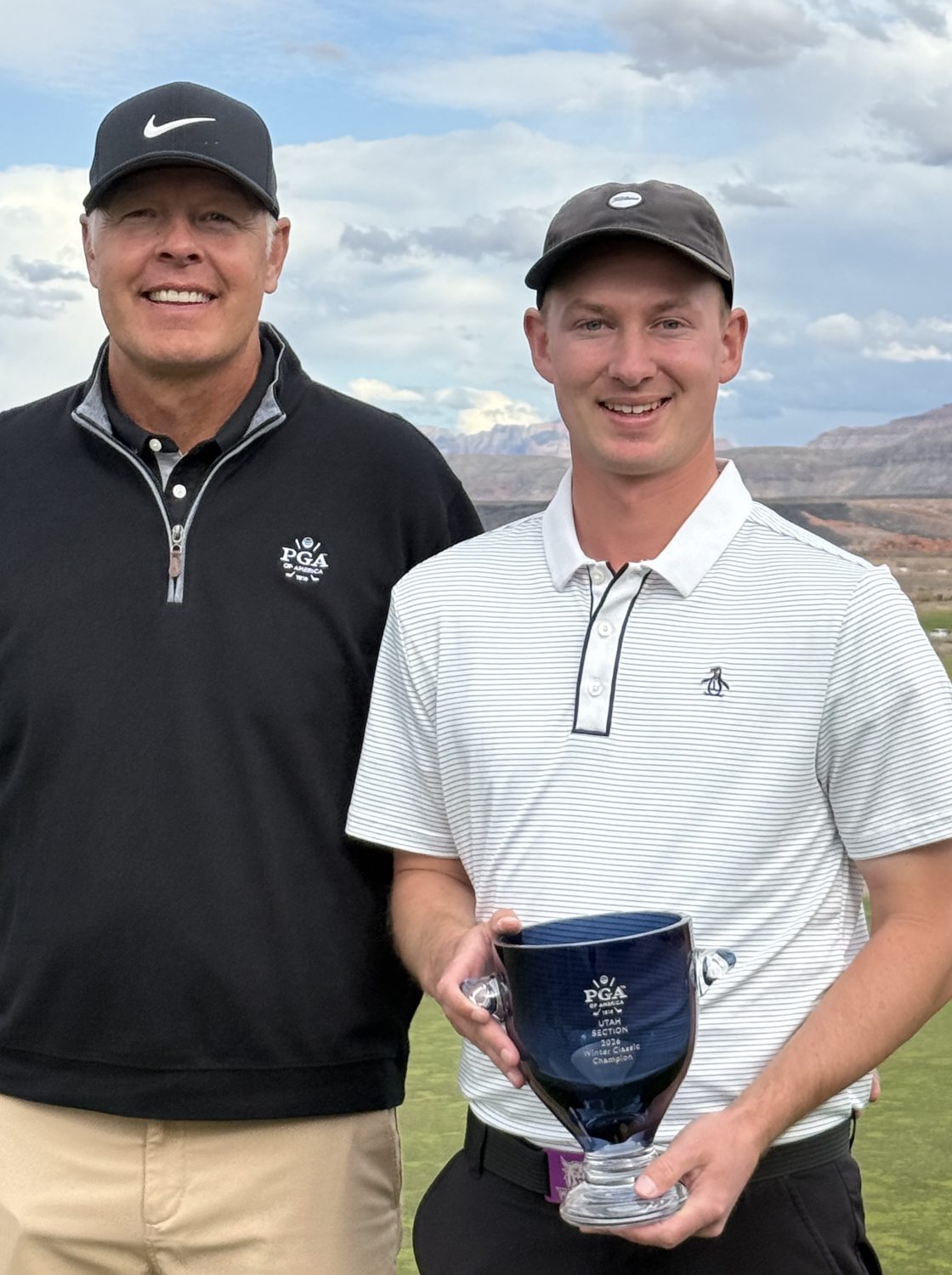
Vice President Tracy Zobell presented the RMT/EZGO Winter Classic trophy to PGA Associate Hayden Banz, his first Utah PGA title.
Competition set the tone. The RMT/EZGO Winter Classic, contested at Coral Canyon Golf Course and Sand Hollow Resort in Stableford scoring format, drew another deep field of professionals eager to test their games and shake off the offseason. Nibley Park teaching professional and PGA Associate Hayden Banz delivered the performance of the week, opening with a remarkable 52 point round that set a commanding pace and ultimately secured his first Section title. Also earning title recognitions were Dustin Volk (Senior), Steve Schneiter (Super Senior) and Bob Rudd (Legends) in their respective divisions.
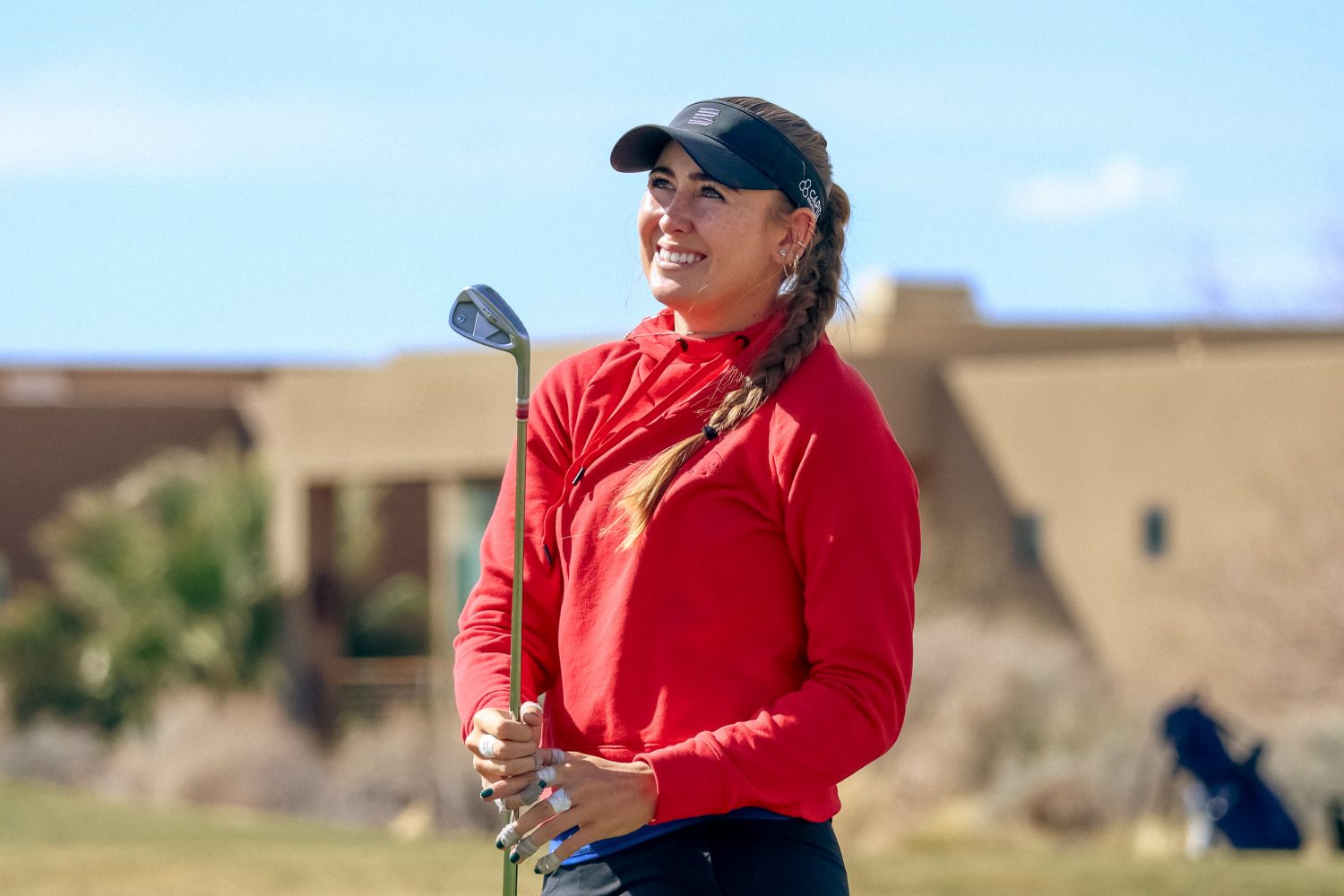
PGA Associate Ali Mulhall won the Women’s Division title.
In the women’s division, Section newcomer Ali Mulhall added another win to her growing résumé, while several veteran players reminded everyone that experience is key in Section events. Chasing Mulhall were Emily Jones, Haley Sturgeon, Kali Quick and Sue Nyhus among others.
As always, the golf itself mattered, but the conversations each day in all divisions carried equal weight.
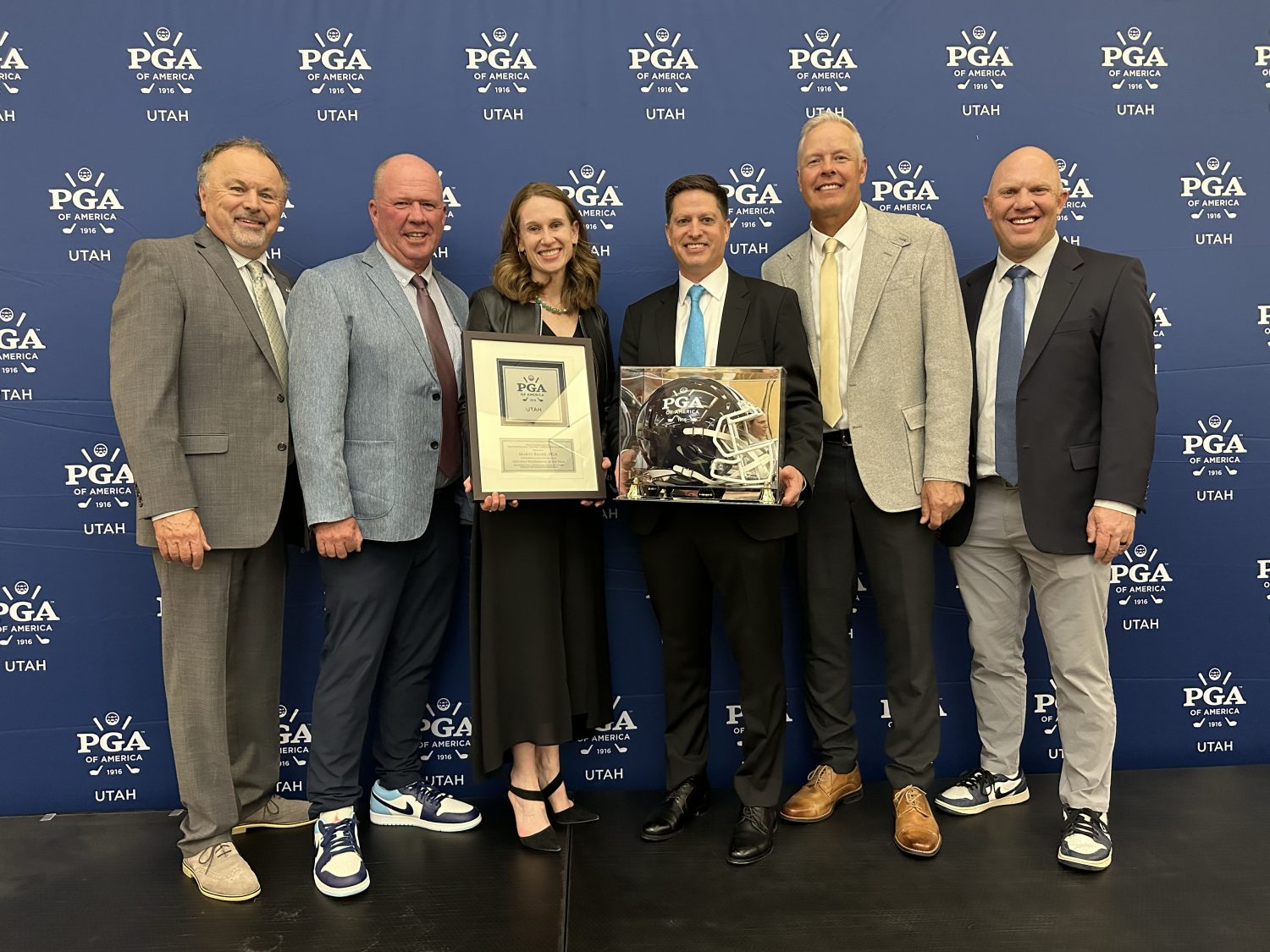
Marty and Kelly Bauer, hold the Utah PGA Professional of the Year hardware along side of Section leadership following the Awards Banquet.
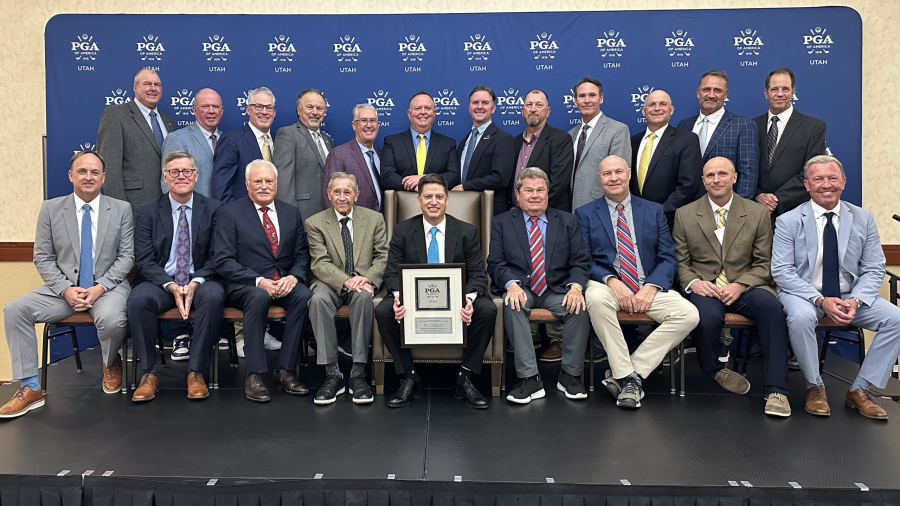
Those conversations took center stage at the Awards Banquet and Annual Meeting, where the Section paused to recognize excellence across the state. The two get-togethers balanced celebration with reflection, honoring achievements while reinforcing a shared responsibility to mentor the next generation. Glenwild’s Marty Bauer, the 2025 Professional of the Year, exemplifies that philosophy through his leadership and commitment to developing assistants and associates. The presence of past award recipients in attendance underscored the continuity of leadership that has defined the Utah Section for decades. The traditional group photo of the Utah PGA Professionals of the Year in attendance, joined by this year’s honoree and his wife Kelly, became a fitting highlight to close the Awards Banquet.
The Utah Section PGA is observing a 40-year anniversary in 2026, and there’s a lot to celebrate.
The newly created Utah Section PGA Hall of Fame will honor Utah PGA Professionals whose careers extended into the era after Utah was awarded its own Section in 1986.
Administrators determined that four decades is sufficient for the Utah Section PGA to have charted its own course of golf history in the state, with a long list of deserving candidates. A second class likely will be honored in 2027, Executive Director Devin Dehlin said, and subsequent groups will be selected every two to four years.
“I’m just excited that we’re getting this going, to be able to honor some of our great professionals,” Dehlin said.
The charter class of the Utah Section PGA Hall of Fame will commemorate the founding of the PGA of America’s newest Section, with several of the nine inductees having been instrumental in both that campaign and the early years of the Section’s operation.
The class includes Tee Branca, Jeff Beaudry, John Evans, Robert McArthur, Ken Pettingill, Ernie Schneiter Jr., Jimmy Thompson, Doug Vilven and Scott Whittaker.
“I look at all the (professionals) who laid the groundwork for all of this,” said Section President Craig Norman. “The work they did to get it off the ground was amazing.”
Dehlin and other administrators are proud to look back at what the Section has achieved in its first four decades and, he said, “It will be fun to see our Hall of Fame grow over the next 40 years.”
The Class of 2026:
TEE BRANCA
The inscription on the plaque adorning the Tee Branca Bridge concludes with a tribute to “a gentleman, friend and professional.”
Those labels capture the life of Branca, who’s revered as the longtime Head Professional of The Country Club in Salt Lake City. Branca’s legacy is so tied to his personality and the way he treated people that it is difficult to quantify. Longevity is certainly one measure of his impact.
Consider that 55 years after competing in a playoff for a PGA Tour title in the 1938 Utah Open, Branca was honored as both the Golf Professional of the Year and the Merchandiser of the Year (Private) by the Utah Section PGA. Those awards came in 1993, two years after Branca became a charter member of the Utah Golf Hall of Fame.
His 51-year tenure of directing the golf operation at The Country Club, where he had worked as a caddie since shortly after the club’s relocation to the current site in 1921, took him into the era of Utah’s becoming its own PGA Section. So it would be difficult to imagine a Utah Section PGA Hall of Fame without Branca as a charter member.
After his passing in 1999 at age 87, Branca’s life story cited his “ability to to have love and unconditional respect for all people.”
That’s how he’s known to this day in the Section, as someone who treated all of his fellow professionals the same way, whether they were in similar positions at prestigious country clubs or working at nine-hole municipal venues.
Branca’s selection to the Section’s Hall of Fame comes in a year when his sons, Don and Ron, were the honorees of the Utah Senior Open. They have carried on in the gracious tradition of their father, while each has received a Golf Professional of the Year award. Don was among the Section’s first presidents. Ron was an original member of the Section’s Board of Directors and followed Tee as Head Professional of The Country Club.
Tee Branca, whose given name is Atilio, initially worked as an assistant pro at The Country Club before becoming Head Professional of Fort Douglas Country Club in 1935. After a U.S. Army stint, he returned to The Country Club in 1944.
“I was about to go back to Fort Douglas,” Branca said in a 1999 book commemorating the club’s centennial. “But when they offered me this, it was my lifelong desire, so I accepted and have been here ever since.”
When his father turned 80 in 1992, Don Branca predicted that Tee would observe the occasion with a full day’s work. “He loves the game, loves to be around it,” Don said.
That’s the lasting legacy of Tee Branca. The plaque on the bridge framing the No. 11 green notes that the structure is intended “to inspire memories of the past, enjoyment of the present and contemplation of the future.”
JEFF BEAUDRY
One of the Utah Section PGA’s founding fathers remembers the days when the organization’s direction was being formed by “meetings in Jeff Beaudry’s kitchen.”
The recipe was simple, yet intricate: What will make Utah golf the best possible product?
As the Section’s first Executive Director, Beaudry shaped the approach of a group that would be anything but insular. “If there’s something happening in golf,” he said, looking back, “Utah professionals ought to be involved in it.”
Four decades later, that philosophy remains prevalent, and is especially reflected in the way that the professional and amateur governing bodies cooperate in Utah. That’s a big part of the legacy of Beaudry, a charter member of the Utah Section PGA Hall of Fame.
“I can’t give Jeff enough credit for everything he did,” said Robert McArthur, a fellow inductee and one of the Section’s first Presidents.
“Credit to the founding fathers,” Beaudry said, noting how they recognized that “the golf world is bigger than just me.”
He further reflected, “The good of golf is all that matters. That’s what has happened. “I’m still proud of how (subsequent leaders) have persevered.”
The word “steward” is often used in golf administration, preserving the game’s traditions. Beaudry goes a step further with his “servant” label.
A graduate of Cyprus High School, Beaudry made his mark in Magna as the Head Professional of the historic Copper Golf Club. After working briefly as a golf manufacturer’s representative, he took the Section reins in 1986. He held that position for 11 years before moving into various positions with the PGA of America.
In addition to setting the Section’s overall course, Beaudry was instrumental in establishing the PGA’s role in conducting high school state tournaments, In 1990, PGA Sections were asked to run the events of an innovation now called the Korn Ferry Tour. That became a major undertaking for seven years at Riverside Country Club in Provo, with a lasting impact that includes the Section’s relationship with Special Olympics Utah.
Beaudry wanted to do more than merely present a large check after the tournament, so Section administrators launched a golf clinic for Special Olympics athletes. That was among the initial steps of golf’s becoming an official sport in Special Olympics International and created Beaudry’s personal attachment to the cause. And in 2000, the successful partnership was renewed when the Section took over operation of the Utah Open.
In 2017, Beaudry received the PGA of America’s Conrad Rehling Award for contributions to the growth of Special Olympics golf. He was inducted into the Special Olympics Utah Hall of Fame and later served as the board chairman.
A 2015 inductee into the Utah Golf Hall of Fame, Beaudry was the first recipient of what is now the Jeff Beaudry Golf Ambassador Award, presented annually by the Section. He received the Utah PGA Governor’s Golf Industry Service Award in 2016.
JOHN EVANS
Almost every PGA Head Professional has a tree of influence, reflecting their former assistants who have ascended in the business. John Evans’ tree features a branch that’s unlike anything else in Utah Section PGA history.
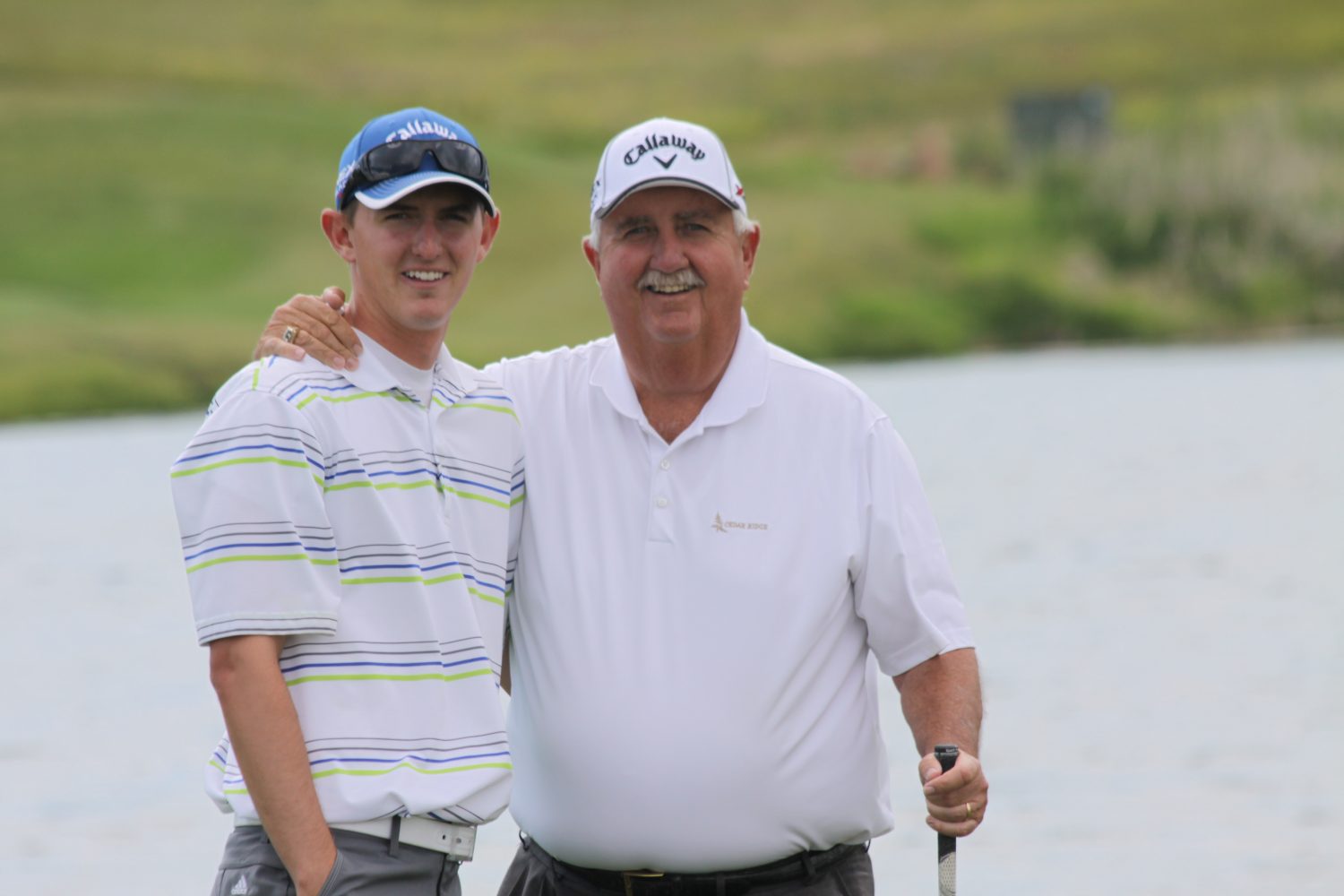
Jared Barnes, Colby Cowan and Chris Stover each worked for Evans at Cedar Ridge Golf Course in Cedar City and went on to become the Section’s Professional of the Year and serve as three consecutive Presidents of the Section. That’s quite a legacy, contributing to Evans’ being named a charter member of the Utah Section PGA Hall of Fame.
“We looked up to him and wanted to do what he did,” Barnes said in 2014, when Evans was the Utah Senior Open honoree. “When I think of John, I think of him as a Section leader.”
Evans’ contemporaries mention his demeanor, which extended to a golf swing that often made the game look easy and a personable nature that “never made anything seem like work” to him, as one of them said.
One of the Section’s first presidents, Evans received the Golf Professional of the Year award in 1995 and the Jeff Beaudry Golf Ambassador Award in 2005,
“You try to surround yourself with good people,” Evans said. “As I was growing our golf course, I was trying to grow the kids that worked for me. … I told every one of them, ‘You need to get involved’“ in the Section.
Barnes, himself a longtime head pro at Cedar Ridge, and Cowan have their own distinctions. Evans nurtured them through junior golf, high school golf and college golf. In 2021, Southern Utah University honored him with the naming of the John Evans Golf Center, where the men’s and women’s teams practice. In 2023, he was inducted into the Southern Utah University Hall of Fame.
Evans moved to Cedar City from Orem, where he was the Head Professional of the nine-hole Cascade Fairways. While in that position, he won his second Provo Open title in 1979 over the likes of Don Branca and Bob Betley. His first victory came in 1966, when he outdueled BYU teammate Johnny Miller and pro Jack Mann in a playoff.
“When I lived up north, that’s what I lived for, was playing golf,” Evans said.
In Cedar City, he focused more on raising his family and expanding a golf course that has become part of the community’s fabric. The goal: “Make something the city could be proud of,” Evans said.
In turn, he once described coming to Cedar City as “the greatest move of my life,” explaining, “It made me a better person, not only because of the golf course but the people down here.”
With an 18-hole facility as the framework, Evans coached Cedar High to two state championships and helped SUU’s program move to Division I during his 31 years as the course’s Head Professional.
ROBERT MCARTHUR
For more than 25 years, Robert McArthur was a highly effective teacher as an adjunct faculty member of the PGA of America’s national program.
Closer to home, history shows that working alongside McArthur provided an outstanding education. Not every golf professional’s impact is easily quantified, but there’s an obvious gauge of McArthur’s success in Utah.
Craig Norman, Kent McComb and Chris Moody, in succession, were McArthur’s assistants during his 39-year tenure as Riverside Country Club’s Head Professional. Each was named the Utah Section PGA’s Assistant Professional of the Year while working in Provo, then each became a Golf Professional of the Year.
Even if McArthur says such associates “made me look better,” he clearly shaped them in influencing Utah golf’s present and future. That’s among the reasons he’s a charter member of the Utah Section PGA Hall of Fame.
“He always had the interest of making well-rounded golf professionals, and he cared about his employees,” said Norman, the Section’s President in 2025-26.
That’s reflected in how McArthur viewed them as “more like younger brothers” than assistants. His approach stems from the way fellow inductee Jimmy Thompson treated McArthur almost like a son, during their time together in American Fork at the course now called Fox Hollow GC.
A native of St. George, where his brother Reed enjoyed his own storied career in the profession, McArthur said he was “taught a long time ago to just work hard and, hopefully, people would recognize that.”
It has happened often in his PGA career. Among his honors are the Section’s 1989 Golf Professional of the Year Award and the 2003 Jeff Beaudry Golf Ambassador Award. In 2020, he became the first recipient of the Doug Vilven Distinguished Service Award. That’s highly meaningful to him, because he and Vilven worked for Thompson, which is how they became interested in PGA education. And they’re all part of the Hall of Fame Class of 2025.
McArthur was driven to “help people along the way; that’s what this business is all about,” he once said. “You kind of get reenergized, going out and teaching young professionals that are coming along. It helps you to refocus on what you’re doing at your club.”
Jeff Beaudry, another charter member of the Utah Section Hall of Fame, appreciated McArthur’s attitude during the seven years when the Section operated the Ben Hogan Utah Classic (now part of the Korn Ferry Tour) at Riverside in the 1990s. His standard answer to any question, Beaudry said, was “We can make that happen.”
Beaudry also marveled at McArthur’s demeanor during a tense meeting with the Utah HIgh School Activities Association as Section members were questioned about their decisions during weather-related stops and starts of a state tournament. McArthur stayed calm under pressure, providing yet another lesson about his role in the profession.
KEN PETTINGILL
Valley View Golf Course in Layton will forever serve as a monument to Ken Pettingill’s work in the profession. The less glamorous evidence of his contributions to the golf community is his work in establishing the financial and operational practices of the Utah Section PGA.
In those early days, “With the business side of operating a Section, he was absolutely invaluable,” said Jeff Beaudry, the Section’s first Executive Director and a fellow charter member of the Utah Section PGA Hall of Fame.
Pettingill, a graduate of Davis High School and Weber State, was the first elected President of the Section, following Lynn Landgren’s role in the transition year of 1986. He also received the Section’s PGA Professional Development Award that year and was named the Golf Professional of the Year in 1990.
The widespread recognition that Valley View received also reflected well on Pettingill, whose tenure covered 35 years, including every aspect of the course’s construction and operation. Having worked at Davis Park Golf Course from that facility’s beginning, he moved slightly north and assumed an expanded role in building Valley View after architect Joe Williams died during the early phase of construction.
Pettingill worked with William Hull, who was hired to do the bunkers and green complexes in a style that resembled Robert Trent Jones’ approach. The ultimate result was a layout (later to be operated by Davis County) that opened in 1974 and earned multiple Top 75 Public Course awards from Golf Digest in the 1980s.
“That really validated us in the golf community in Utah,” Pettingill said. “Valley View became ‘the’ test for really good players.”
That’s evidenced by how the course hosted the 1977 Women’s State Amateur in only its third full year of operation, and by this partial list of distinguished players who won the men’s club championship: Utah Golf Hall of Fame member Todd Barker, plus Kirk Bowler, Brandon Kida, Kurt Owen, David Jennings, Reed Nielsen and Rand Sargent.
And then there are the anecdotal tributes from visitors who wondered how Valley View could charge a modest green fee for such a high-quality venue. As Pettingill once said, “I can’t tell you how many times that would happen in a year. Just dozens and dozens of times.”
Determined to “build it, change it, tweak it, improve it,” he said, Pettingill kept upgrading the course and its maintenance, managing the golf course superintendents and operating the golf shop.
So he takes considerable satisfaction in Valley View’s continued success, as well as the 40-year growth of what he labels “one of the model Sections” in the PGA of America.
Thanks to the staff and board members who followed through, the Section is “well thought-of in the national office,” Pettingill said. “Of course, you have to earn that.”
Pettingill’s son, Chad, has earned two PGA Professional Development Awards of his own. He’s currently the General Manager of The Ledges of St. George. Chad’s son Tanner also is pursuing a career in golf, extending the Pettingill legacy in Utah.
ERNIE SCHNEITER JR.
The Schneiter name is so closely linked to golf In Utah that the charter class of the Utah Section PGA Hall of Fame seemingly has to include a member of the family.
That’s not to diminish the individual accomplishments of Ernie Schneiter Jr., whose playing record, work in course design and construction and service to the game make him a good composite character of the Schneiter family.
Among his many honors is a 2000 Jeff Beaudry Golf Ambassador award. A quarter-century later, with a 95-year-old Ernie still spending most days at Schneiter’s Riverside Golf Golf Course in Riverdale, Lee Benson of the Deseret News seized upon the key word of that award in describing him: “You’d be hard-pressed to find a greater lifetime ambassador for the game in the state, and even harder pressed to find anyone who would argue the point.”
Schneiter was named the Utah Section PGA’s Professional of the Year in 1997. He also received the Utah Golf Association’s 2000 Gold Club Award, with a definition that also captures his most distinguishable traits: “unselfish service … personal integrity, sportsmanship, common courtesy, loyalty and friendship (that) earn the love and respect of fellow golfers.”
In 2004, Schneiter was inducted into the Utah Golf Hall of Fame. In 2023, he received a Distinguished Service Award from the Utah Sports Hall of Fame Foundation.
Citing his love of golf and those who play the game, Schneiter said, “I’ve been really blessed to be able to have done something I really cared about. What a great way to meet people.”
He reflected on his life as “pretty hard to beat, if we’re going to start over.”
The highlights are plentiful. One of them has to be Schneiter’s victory in the 1966 Utah Open at Ogden Golf & Country Club, the origin site of his family’s golf story. At age 36, then working as the Head Professional at Ben Lomond Golf Course, he shot 70-68-71 to edge contenders including Chick Evans, Bruce Summerhays and Dale Douglass. As he told The Salt Lake Tribune that day, “This victory is the best I’ve had in golf, and it means more to me because I started playing on this course.”
He also qualified three times for the PGA Championship, including the 1968 tournament in San Antonio. A half-century later, he accurately recounted tying Jack Nicklaus, as each of them missed the 36-hole cut by one stroke.
The Schneiter legacy is strongly tied to public golf facilities in Utah, and Ernie’s fingerprints are all over two of them. He helped his father build Riverside GC, and later took over the operation and built an additional nine holes. In western Davis County, he bought property and built Schneiter’s Bluff GC, where, as he once said, “We’re going to try and give it some personality.”
The result is another fun, playable course that family members operate and maintain as a key component of the Utah golf community.
JIMMY THOMPSON
Oklahoma native Jimmy Thompson spent much of his professional life in California, so he’s occasionally confused with former Los Angeles Open champion Jimmy Thomson.
In the Utah golf community, though, there’s no mistaking Thompson’s lasting influence. Doug Vilven and Robert McArthur, also charter members of the Utah Section PGA Hall of Fame, have cited him as an important mentor.
So did Tommy Sharp, a two-time Section Teacher of the Year. Upon Thompson’s passing in 2006, Sharp wrote, “He taught me countless things about the golf swing and control of self (‘COS’). But more importantly, he taught me life lessons that one could never forget,”
In the last phase of his career, Thompson worked at Vilven’s Golf in the Round facility in South Salt Lake. That’s where, at age 76, Thompson was named the Section’s Teacher of the Year in 1995. That followed recognition such as the Utah Golf Association’s Gold Club Award in 1991 and Utah Golf Hall of Fame induction in 1998.
Every spouse of a dedicated golf professional makes personal sacrifices. Not all of them, though, have a line like this one in their life stories: The former Helen Micks of Muskogee, Oklahoma, was said to have “married golf and Jimmy E. Thompson.”
As McArthur said, “You can’t say ‘Jimmy’ without ‘Helen.’”
Beyond that, McArthur added, “Their ‘kids’ were the golf professionals who worked for them.”
McArthur was Thompson’s longtime assistant in American Fork at the course originally called Tri-City (now Fox Hollow Golf Club). Thompson’s original stint in Utah began at Timpanogos GC in Provo in the late 1940s, where he influenced brothers Jerry and Sonny Braun as future PGA Professionals. Vilven launched his professional career under Thompson in California in 1971.
Thompson’s influence “is what really sparked Doug and I to get involved on more of an education level,” McArthur said, as they became teachers in the PGA of America’s schools.
Tom Addis, a former President of the PGA of America, wrote about Thompson’s “leadership and never-ending support of the PGA Golf Professional and the game of golf,” adding, “He was especially a guiding light for me and my career.”
Thompson’s initials created his nickname of “JET.” He was known for his cardigan sweater, bucket hat, steady demeanor and devotion to the profession. As life story mentioned, in citing his stops in Oklahoma, California and Utah, “If any of these courses had been open 24 hours, Jimmy would have been there. He loved his work and the people he met.”
That stemmed from Thompson’s childhood of essentially being raised by golf professionals after his parents’ divorce, McArthur said. Thompson would spend the rest of his life by returning the favor as mentor to more than two dozen assistants who became head professionals.
DOUG VILVEN
Ask anyone about the founding of the Utah Section PGA, and one story consistently emerges. The unofficial title: “Doug Vilven and the Map.”
Modern measuring devices play a major role in golf, yet no implement is more central to Utah’s history of the game than the overlay that Vilven used to illustrate how the state’s golf professionals deserved to have their own PGA Section. He showed PGA of America administrators how the Rocky Mountain Section stretched from the Canadian border to Southern Utah, applying that measurement to the East Coast of the United States and its numerous Sections.
He got the point across. Utah became the 41st PGA Section in 1986. So of all the roles Vilven played in his golf career, “geographer” might be the most important. That’s also among the reasons he’s a charter member of the Utah Section PGA Hall of Fame.
“That’s how he fought for it,” Vilven’s wife, Denise, said of the Section’s creation.
“It would not be a stretch to say Utah would not exist without Doug Vilven,” said Jeff Beaudry, the Section’s first Executive Director, noting that PGA administrators “were in no hurry to grant another Section, after two years of lobbying.”
Vilven never stopped advocating for the Section and its members, until his passing in 2018 at age 70. He also was committed to the profession more broadly, teaching in the PGA of America’s schools as an original faculty member of the national training program.
The Utah Section PGA could have named its annual PGA Professional Development Award after him, considering he received that honor eight times in a 27-year span. The Section did establish the Doug Vilven Distinguished Service Award in 2020. More evidence of Vilven’s extended impact in Utah were his two Golf Professional of the Year awards, his 2010 Jeff Beaudry Golf Ambassador Award and his 2021 induction into the Utah Golf Hall of Fame.
Vilven served as a longtime rules official in Utah tournaments and was a commentator for local telecasts of the PGA Tour Champions event at Jeremy Ranch.
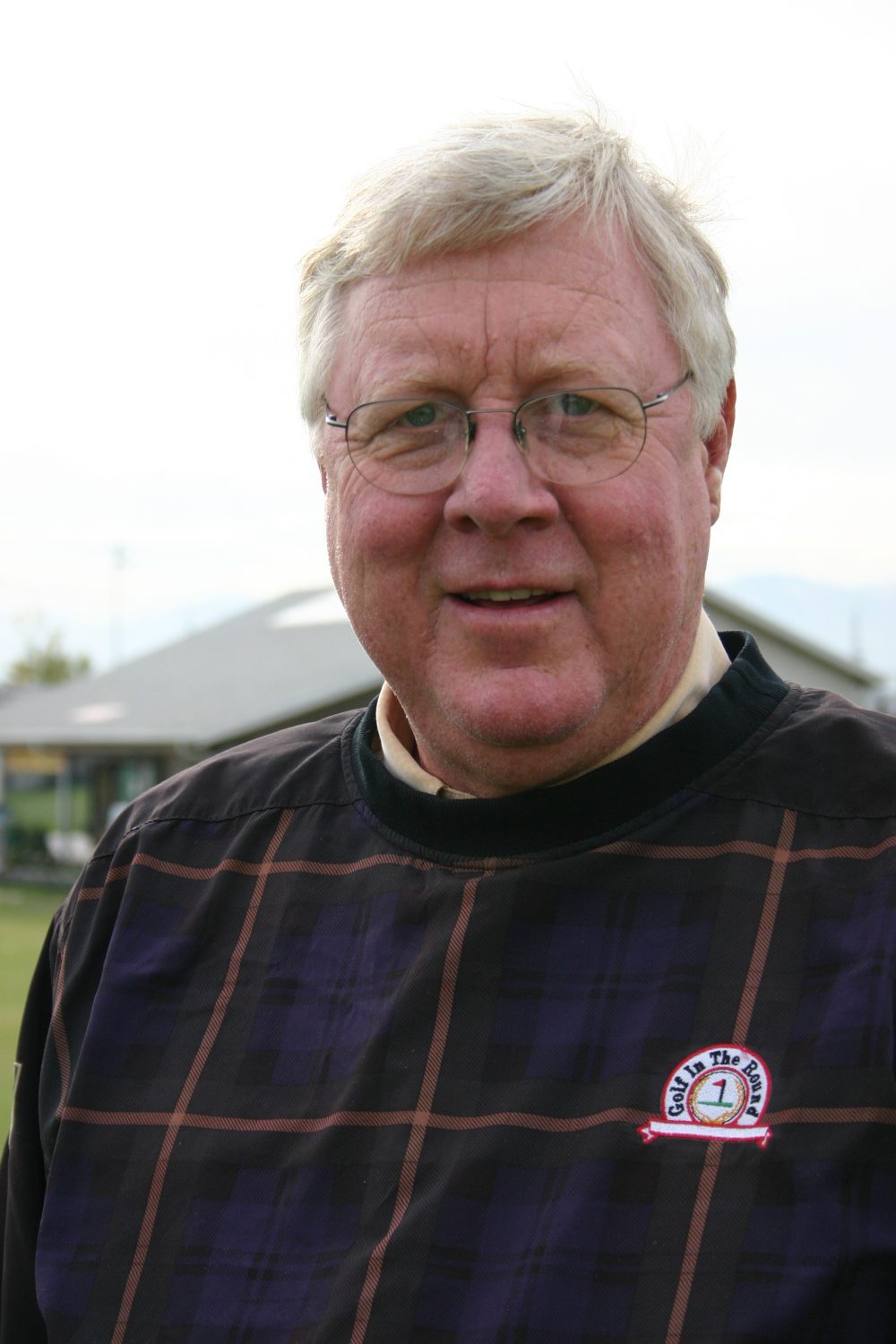
A former Highland High School and Utah State golfer, Vilven was influenced by working under Thompson and Tee Branca, another charter member of the Utah Section PGA Hall of Fame. He enjoyed stints as Head Professional of Oquirrh Hills Golf Course in Tooele and Park City Golf Club, before his visionary nature took hold in 1992 when he launched the facility originally called Golf in the Round, with a gigantic, half-circle driving range and nine-hole executive course in South Salt Lake.
Vilven relied on others, notably his wife, to help implement and follow through on that vision. The result is a facility that plays a vital role in the growth and sustainability of golf in Utah and serves as further proof of Vilven’s lasting influence.
SCOTT WHITTAKER
In a digital age, Scott Whittaker still loves to draw numbers on hand-written scoreboards. Yet while he’s a traditionalist in many ways, Whittaker also is known for his innovative ideas.
That trait is the subject of both admiration and playful banter from his colleagues in the golf profession, who kid him about his volume of suggestions. The truth is, a lot of them have worked out wonderfully, leading to Whittaker’s induction into the Utah Section PGA Hall of Fame.
The growth of high school girls golf in Utah and the rebirth of the historic Utah Open with a devoted title sponsor are just two of Whittaker’s success stories as the Section’s Executive Director. Credited as one of the Section’s founders, having written its first constitution, he later served as a PGA of America board member.
Screenshot
The experience of helping launch the Section’s operation “was a challenge,” Whittaker said, “but I wouldn’t trade it for anything.”
Don Whittaker once asked his son if he really believed it was possible to make a living in golf. Scott Whittaker made that happen, while making an impact in the Utah golf community.
It all started when childhood friend Ken Pettingill, another charter member of the Utah Section PGA Hall of Fame, persuaded him to join in riding their bicycles to Oakridge Country Club, where they caddied. While working in the early days of Davis Park Golf Course, Whittaker said Head Professional Pierre Hualde “taught me the real, integral things that made a difference in dealing with people.”
Whittaker went on to enjoy a long tenure as Head Professional at Bountiful Ridge Golf Course, starting with the facility’s opening in 1975, before taking the Section position. In 2000, he led the Section’s move to operate the Utah Open, essentially saving the tournament that will celebrate its centennial in 2026.
He described the tournament as “too valuable of an asset to let it go.”
Whittaker’s drive to maximize the Utah Open’s potential is now reflected in the remarkable staging of eight pro-am events during the tournament week.
In the Utah Section PGA’s 40-year history Whittaker is the only member to be recognized three times as the Golf Professional of the Year. He was inducted into the Utah Golf Hall of Fame in 2021. Other honors include the Jeff Beaudry Golf Ambassador Award in 2019 and the Doug Vilven Distinguished Service Award in 2022.
Noting his goal was always “honoring the game,” Whittaker said any of his ideas had to pass this test: How would it serve Utah golf?
“That was an attitude I picked up from all the people around me,” he said, and that’s part of the origin story of the Golf Alliance for Utah, bringing together the amateur professional governing bodies and other stakeholders for the good of the game in the state.
Utah Section PGA Hall of Fame feature written by Fairways Media senior writer Kurt Kragthorpe. Photography courtesy of Fairways Media.